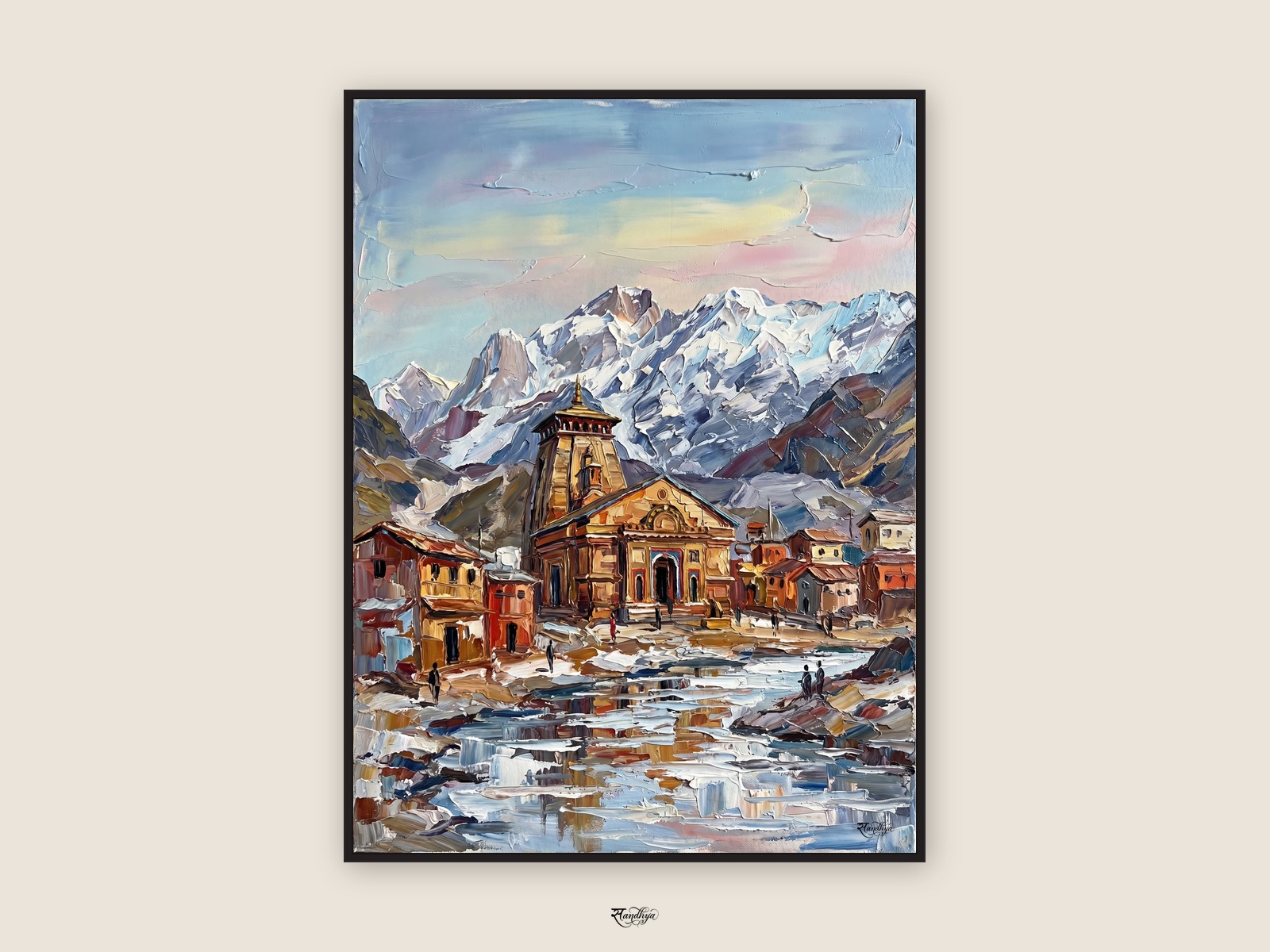
Badrinath Temple
Badrinath Temple stands small and resolute against the enormous Himalayan peaks that dwarf it — a stone shrine painted in warm earth tones at the base of mountains rendered in sweeping strokes of blue-grey, white, and pale violet. This is one of the four Char Dham pilgrimage sites, and Sandhya paints it not as a grand monument but as what it is: a human gesture of devotion in a landscape that humbles everything human.
The temple itself is built in compact palette knife strokes of ochre, burnt sienna, and touches of red, its pagoda-style roof and entrance arch the warmest tones in the composition. The surrounding village — lodges, dharamshalas, small shops that serve the pilgrims — clusters around the temple in blocks of muted colour, their flat roofs dusted with what might be early snow or simply the pale grey of Himalayan stone.
But the mountains are the true subject. They fill the upper two-thirds of the canvas in dramatic knife-work — the snow-covered peaks in thick white impasto that catches real light on its ridges, the rocky slopes in broad diagonal strokes of blue-grey and umber, the glacial valleys in cold shadows of indigo. The sky above is surprisingly warm — pale gold and pink — suggesting either dawn or the brief window before sunset when Himalayan light turns theatrical. A frozen stream or early snowmelt in the foreground reflects the cold blue of the peaks, anchoring the composition in the extreme altitude where this temple has stood for over a thousand years.
What is Badrinath Temple and where is it located?
Badrinath Temple is one of the four Char Dham pilgrimage sites in the Indian Himalayas, located at 3,133 metres elevation in Uttarakhand. Dedicated to Lord Vishnu, it is open only six months a year due to extreme winter conditions. Sandhya Kaushik paints it dwarfed by the surrounding peaks, emphasising the devotion required to build and maintain a shrine at such extreme altitude.