Haridwar Har Ki Pauri
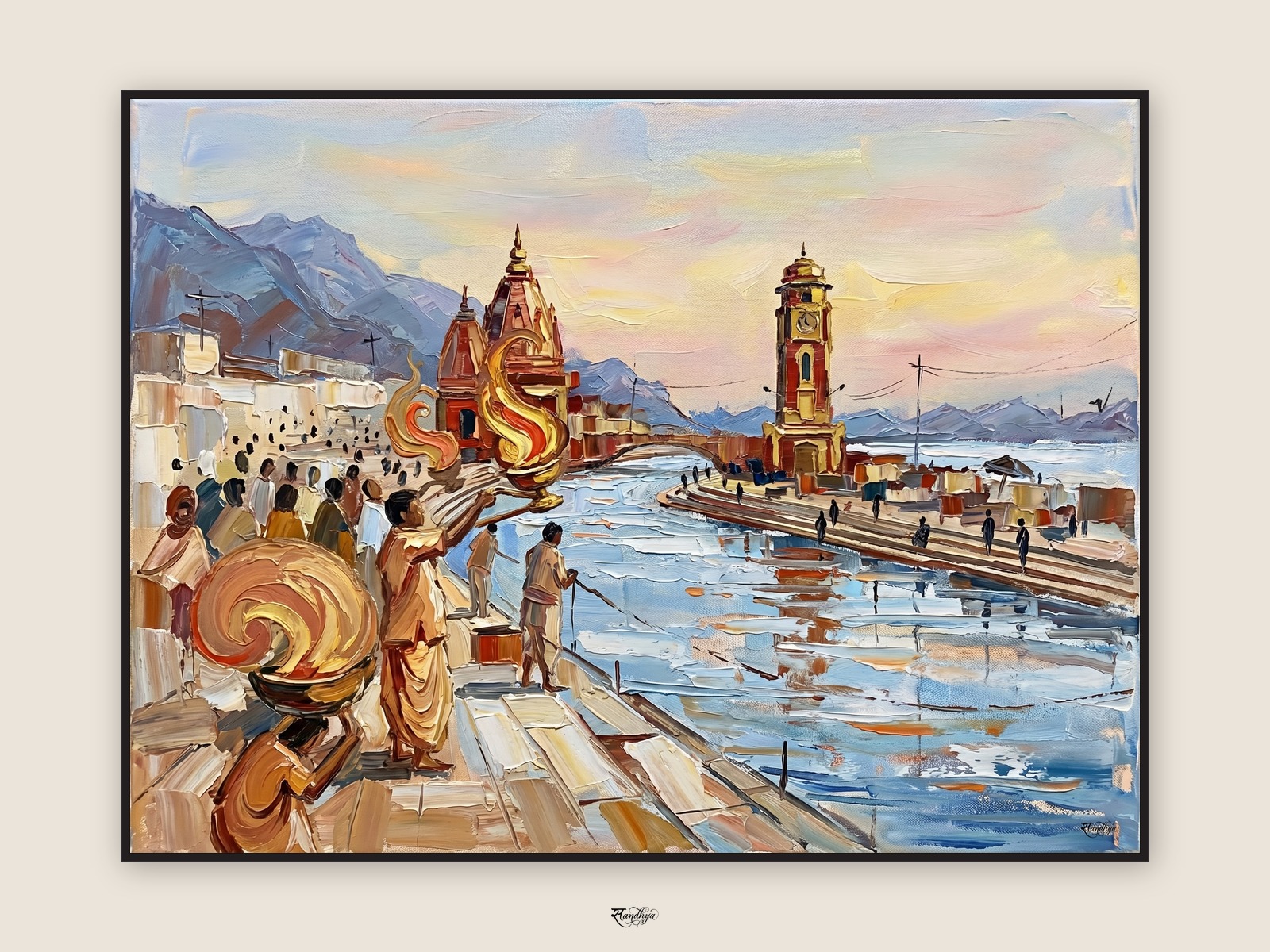
Har Ki Pauri at Haridwar — the sacred step where the Ganga enters the plains after its descent from the Himalayas. Sandhya paints the ghat during the evening aarti, when priests swing enormous flaming brass lamps in choreographed arcs while pilgrims crowd the steps to receive darshan of the holy river.
The foreground places the viewer among the priests. Two figures in saffron robes hold massive multi-tiered aarti lamps, their circular fire-bearing platforms rendered in thick strokes of brass-yellow and cadmium orange. The flames themselves are built in quick, confident impasto — vertical dabs of bright yellow and white that suggest the fierce heat of ghee-fed fire. The priests' robes catch the firelight in warm folds, painted with broad knife-strokes that give the fabric weight and movement.
Behind this ceremonial foreground, the scene opens to the full breadth of Har Ki Pauri. The clock tower — Haridwar's most recognisable landmark — rises in strokes of warm terracotta and sandstone against a sunset sky of pale gold and lavender. The Shiva temple's red shikhara punctuates the middle distance with its ornate spire. The Ganga itself is a masterwork of reflective painting — the water breaks the golden sunset into fragments of amber, blue-white, and pale grey, its current visible in the directional brushwork that pulls the reflections downstream. The Shivalik hills in the background are rendered in soft strokes of blue-grey and mauve, placing this sacred geography precisely where mountain becomes plain, where the divine river first becomes accessible to human devotion.
What is Har Ki Pauri in Haridwar?
Har Ki Pauri (meaning 'Footstep of God') is the most sacred ghat in Haridwar, Uttarakhand — the exact point where the River Ganga emerges from the Himalayan foothills onto the North Indian plains. Every evening, a spectacular Ganga Aarti is performed here with massive flaming lamps. Sandhya Kaushik paints the ceremony in progress, capturing the fire, the faithful, and the Shivalik hills that frame this sacred geography.