Venice Canals
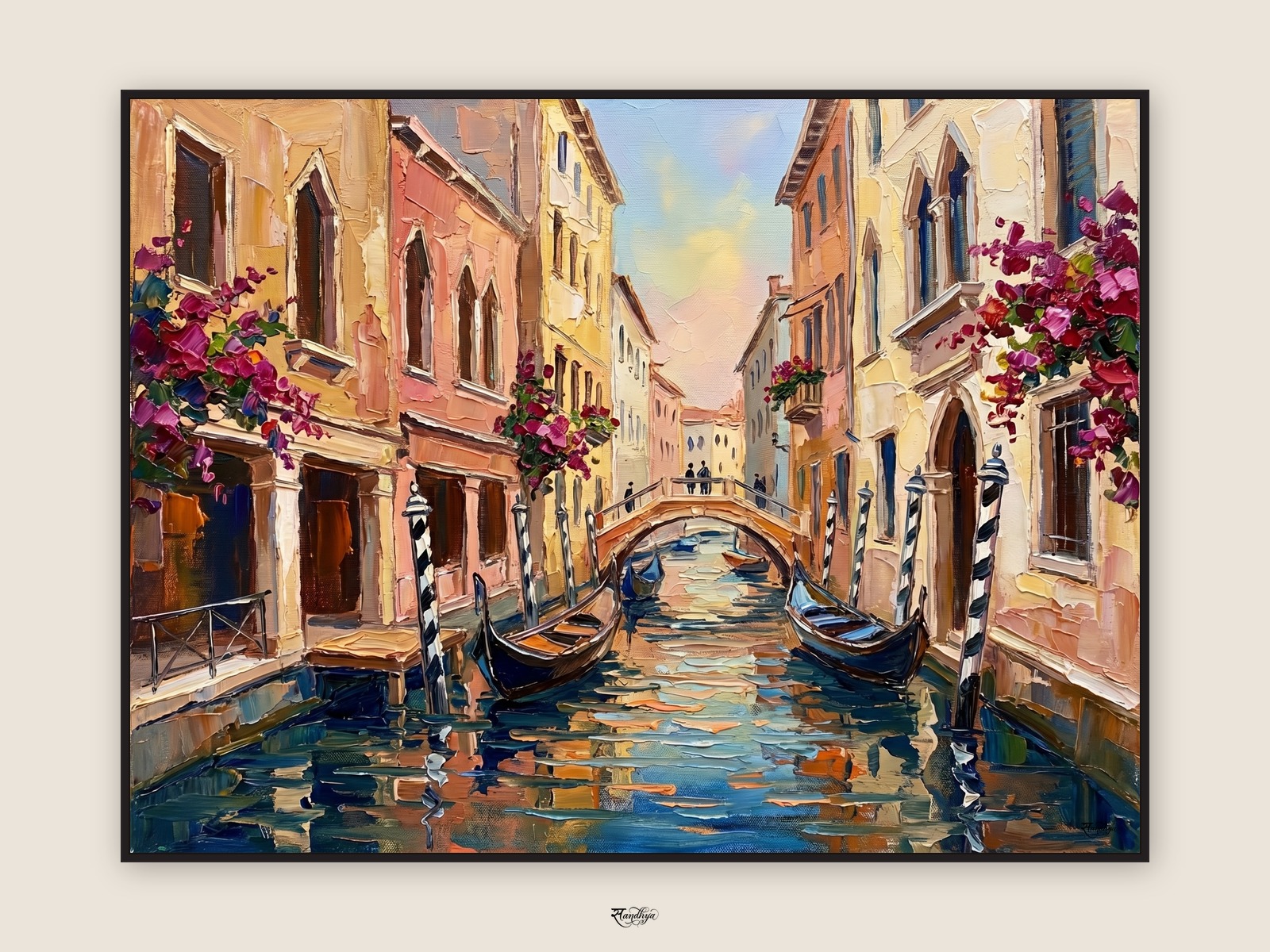
A narrow Venetian canal in afternoon light — the water a corridor of shifting teal, jade, and reflected gold between tall palazzo walls in faded pink, warm cream, and sun-bleached ochre. Sandhya brings her palette knife technique to Venice and discovers a city that responds to impasto as naturally as Varanasi — old plaster, weathered stone, and water that carries the architecture on its surface.
The composition draws the eye along the canal's vanishing perspective. The buildings on either side lean inward slightly, their facades built in broad vertical knife-strokes that suggest centuries of layered plaster and exposed brick. The left wall glows in warm tones of peach and salmon, its shuttered windows dark rectangles of deep umber. The right side is cooler — pale cream and soft grey — creating a natural light-and-shadow dynamic across the canal. Window boxes and climbing bougainvillea in thick dabs of bright magenta, deep pink, and purple spill from upper storeys, adding chromatic intensity against the muted walls.
Two gondolas rest in the middle distance, their sleek black hulls painted in confident single strokes of near-black. A stone bridge arches across the canal in the background, its warm sandstone catching the light in a crescent of pale gold. Figures cross the bridge in tiny silhouettes. The canal water is the painting's quiet triumph — horizontal knife-strokes of teal, blue-green, and reflected amber that fragment the buildings' colours into a shimmering mosaic. The reflections never mirror exactly; they reinterpret. This is Venice as a painter's city — and Sandhya proves that Indian impasto and Italian light share a language that needs no translation.
Why does an Indian painter paint Venice?
Sandhya Kaushik's portfolio extends beyond India to explore cities where water, light, and architecture converge — the same elements that define her beloved Varanasi and Mathura ghats. Venice's canals, weathered plaster walls, and liquid reflections respond naturally to her palette knife technique. The painting demonstrates that impasto is a universal language: the same loaded knife that builds Varanasi's sandstone ghats can render Venetian palazzo walls with equal conviction.