Vrindavan Banke Bihari
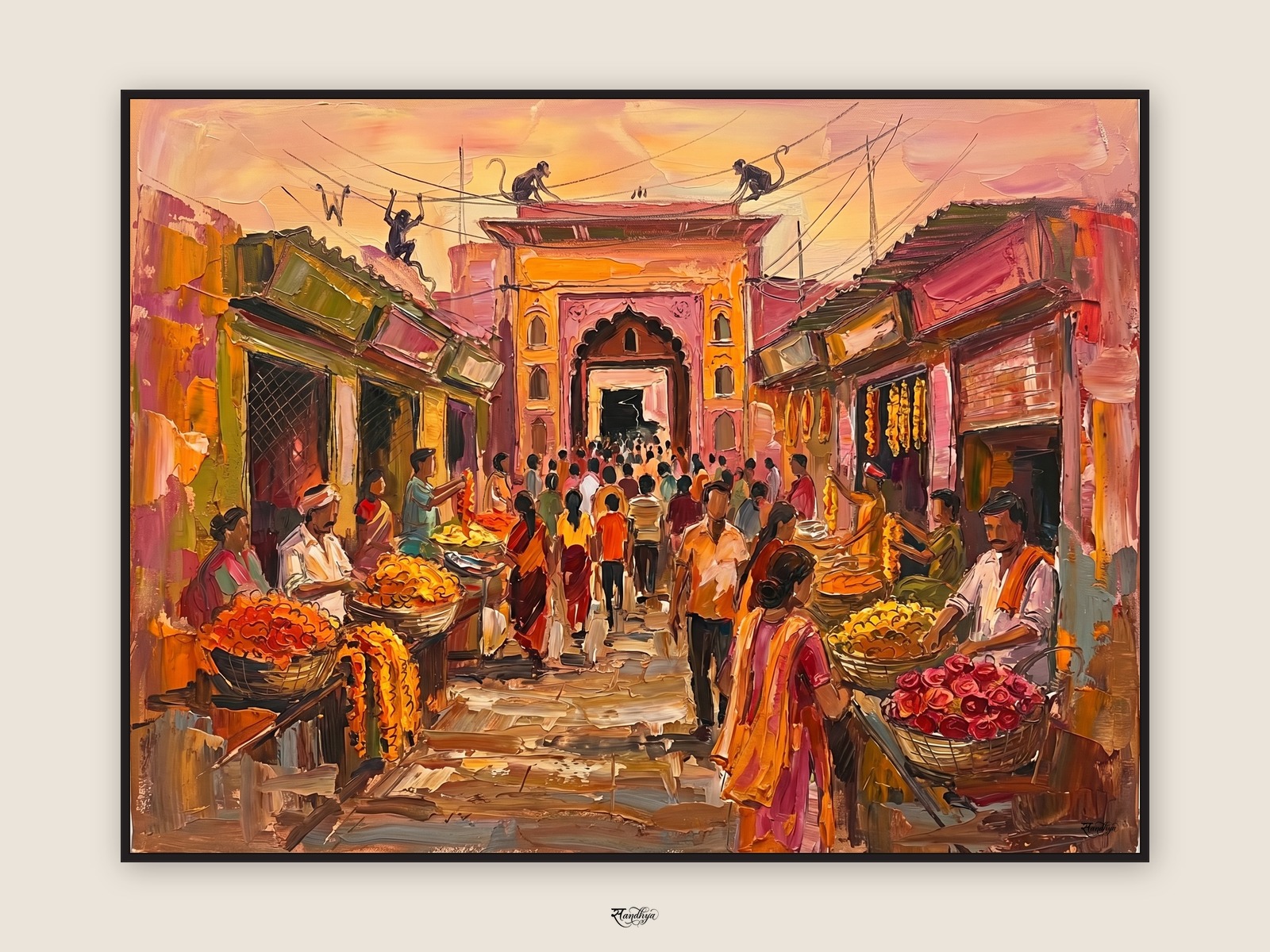
The approach to Banke Bihari Temple in Vrindavan — not the sanctum itself, but the teeming lane that leads to it, choked with devotees, flower sellers, sweet shops, and the particular energy of a place where commerce and devotion have merged so completely that separating them would destroy both.
Sandhya paints this scene from street level, placing the viewer in the thick of the crowd. The temple's ornate gateway rises in the background — its pink-washed facade and arched entrance rendered in strokes of deep rose, terracotta, and warm cream. Above the gateway, the temple's upper structure catches the golden light in pale ochre and touches of bright saffron. But the gateway is framed and partially obscured by the market lane's overhead chaos — wires, awnings, hand-painted signs — rendered in quick, gestural strokes that convey clutter without itemising it.
The real subject is the crowd and the commerce. In the foreground, flower sellers display mountains of marigolds, roses, and jasmine in baskets and on carts — thick impasto dabs of bright orange, deep red, magenta, and yellow-green that create the most chromatic passage in Sandhya's entire portfolio. Devotees in saris of every colour move through the lane — saffron, pink, green, white — their figures suggested in fluid knife-strokes that convey movement and number without individual detail. The ground reflects the warm light of the setting sun in streaks of gold and amber, while deep purple shadows gather in the gaps between stalls. Monkeys perch on rooftops in small dark silhouettes — the temple's famously bold langurs who are as much a part of Banke Bihari as the deity within. This is Vrindavan as lived experience, not postcard view.
What is Banke Bihari Temple in Vrindavan?
Banke Bihari Temple is one of the most visited Krishna temples in Vrindavan, Uttar Pradesh — famous for its unique darshan where the curtain is periodically drawn and opened rather than left permanently open. The approach lanes are legendary for their vibrant flower markets and dense crowds. Sandhya Kaushik paints the approach rather than the sanctum, capturing the fusion of devotion and commerce that defines Vrindavan street life.