Agra Fort Taj View
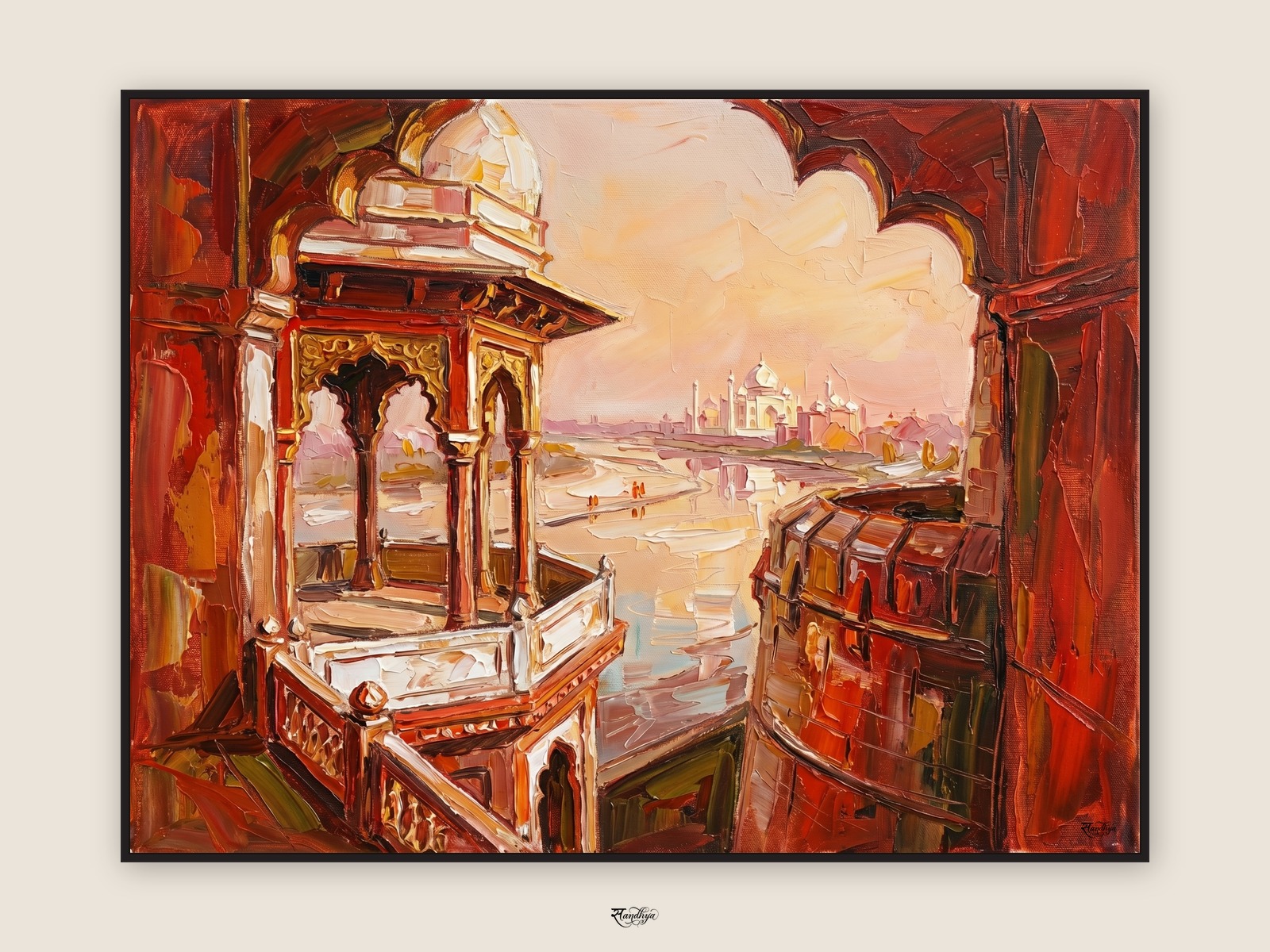
The Taj Mahal seen through a scalloped Mughal arch of Agra Fort — the white marble mausoleum floating in the hazy distance like a memory of grief made permanent, framed by the deep red sandstone of the fort's Musamman Burj. This is the view that Shah Jahan is said to have gazed upon during his eight years of imprisonment by his son Aurangzeb — the tomb of his beloved wife visible but unreachable, across the bend of the Yamuna.
Sandhya saturates the foreground in rich, heavy impasto of Indian red, burnt sienna, and deep umber. The fort's architecture dominates — the cusped arch frames the composition, its scalloped edge carved out in dark red-brown strokes against the pale sky beyond. A marble pavilion or chattri on the left is rendered in strokes of warm gold, cream, and touches of amber, its columns and dome catching the afternoon light. The sandstone balustrade and carved jharokha screens are built in thick textural layers that convey the weight and warmth of Mughal masonry.
Through the arch, the Taj Mahal appears in remarkably soft tones — pale cream, touches of rose, cool grey shadows — deliberately understated against the aggressive warmth of the fort. The Yamuna below is a pale band of reflected light, painted in thin horizontal strokes of silver-blue and gold. The sky behind the Taj is a luminous wash of pale gold fading to warm peach, its softness heightening the contrast with the fort's muscular red. The entire painting is a study in emotional distance — warmth in the near, coolness in the far — echoing the historical tragedy of a man surrounded by red stone walls, looking across water at the monument he built for love but could no longer touch.
Why is the view of the Taj Mahal from Agra Fort historically significant?
Emperor Shah Jahan, who built the Taj Mahal for his wife Mumtaz Mahal, was imprisoned in Agra Fort by his son Aurangzeb in 1658. He spent his last eight years in the Musamman Burj, a marble tower with a direct view across the Yamuna to the Taj. Sandhya Kaushik paints this exact viewpoint — the white tomb framed through a red sandstone arch — making visible the emotional distance between a grieving man and the monument to his love.