Gwalior Fort
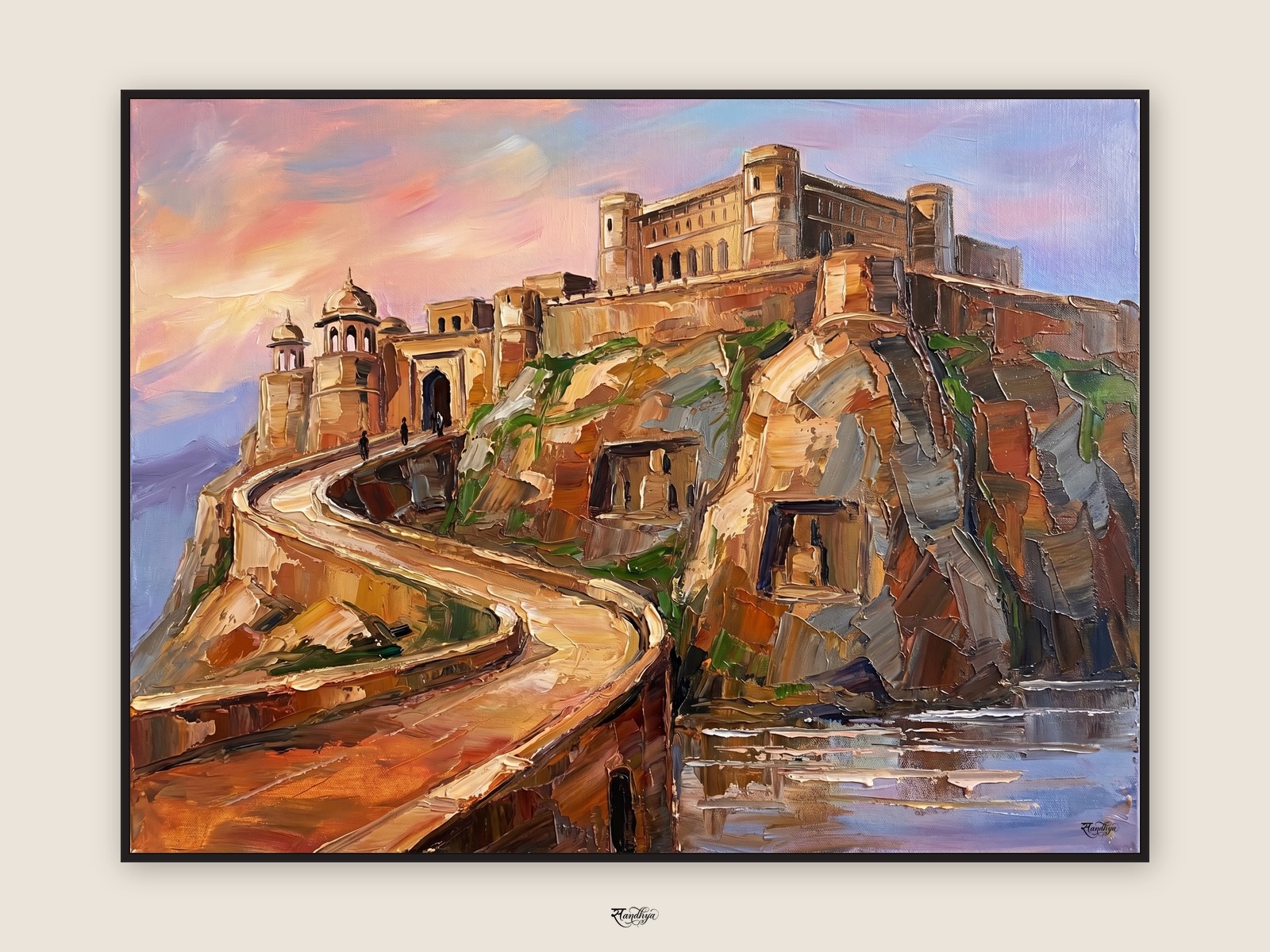
Gwalior Fort commands its sandstone cliff like a ship's prow cutting through the Madhya Pradesh plains — the massive ramparts and palace walls rising in near-vertical faces of golden-brown stone above a winding approach road that switchbacks up the escarpment. Sandhya paints it from a three-quarter angle that emphasises both the cliff's geological drama and the architectural audacity of building a city-fortress atop it.
The cliff face dominates the lower two-thirds of the canvas. Sandhya renders the exposed sandstone in heavy, angular palette knife strokes of warm ochre, raw sienna, burnt umber, and touches of olive green where vegetation clings to fissures. The geological strata are visible — horizontal bands of different stone colours that give the cliff a layered, sedimentary character. Built directly atop this natural foundation, the fort walls continue the verticality in dressed stone — the Man Singh Palace with its round towers and carved facades rendered in strokes of golden sandstone and deep shadow. The winding road up the cliff face is painted as a pale ribbon of ochre and cream, its hairpin turns creating a serpentine rhythm against the cliff's bulk.
The sky occupies the upper third — a dramatic sunset wash of coral, warm pink, pale gold, and soft lavender that silhouettes the fort's skyline of domes, towers, and crenellated walls. The palace roofline catches the last direct light in bright strokes of cadmium yellow and warm amber. In the foreground below the cliff, the old city clusters in muted earth tones — flat roofs, temple spires, and the suggestion of narrow lanes rendered in small marks of brown, ochre, and grey. A body of water at the cliff's base reflects the warm sky in horizontal strokes of pale rose and gold. This is the fortress that made every invading army pause — and Sandhya makes the viewer understand why, rendering the sheer physical impossibility of the approach in paint that feels as heavy and unyielding as the stone itself.
Why is Gwalior Fort considered impregnable?
Gwalior Fort sits atop a 100-metre sandstone plateau with near-vertical cliff faces on all sides, making it one of the most naturally defended fortresses in India. The Mughal emperor Babur called it 'the pearl amongst fortresses of Hind.' Its only approach is a steep, winding road that exposes attackers to fire from above. Sandhya Kaushik emphasises this by painting the cliff and fort as a continuous vertical mass — natural geology and human architecture fused into a single defensive wall.