Amber Fort Jaipur
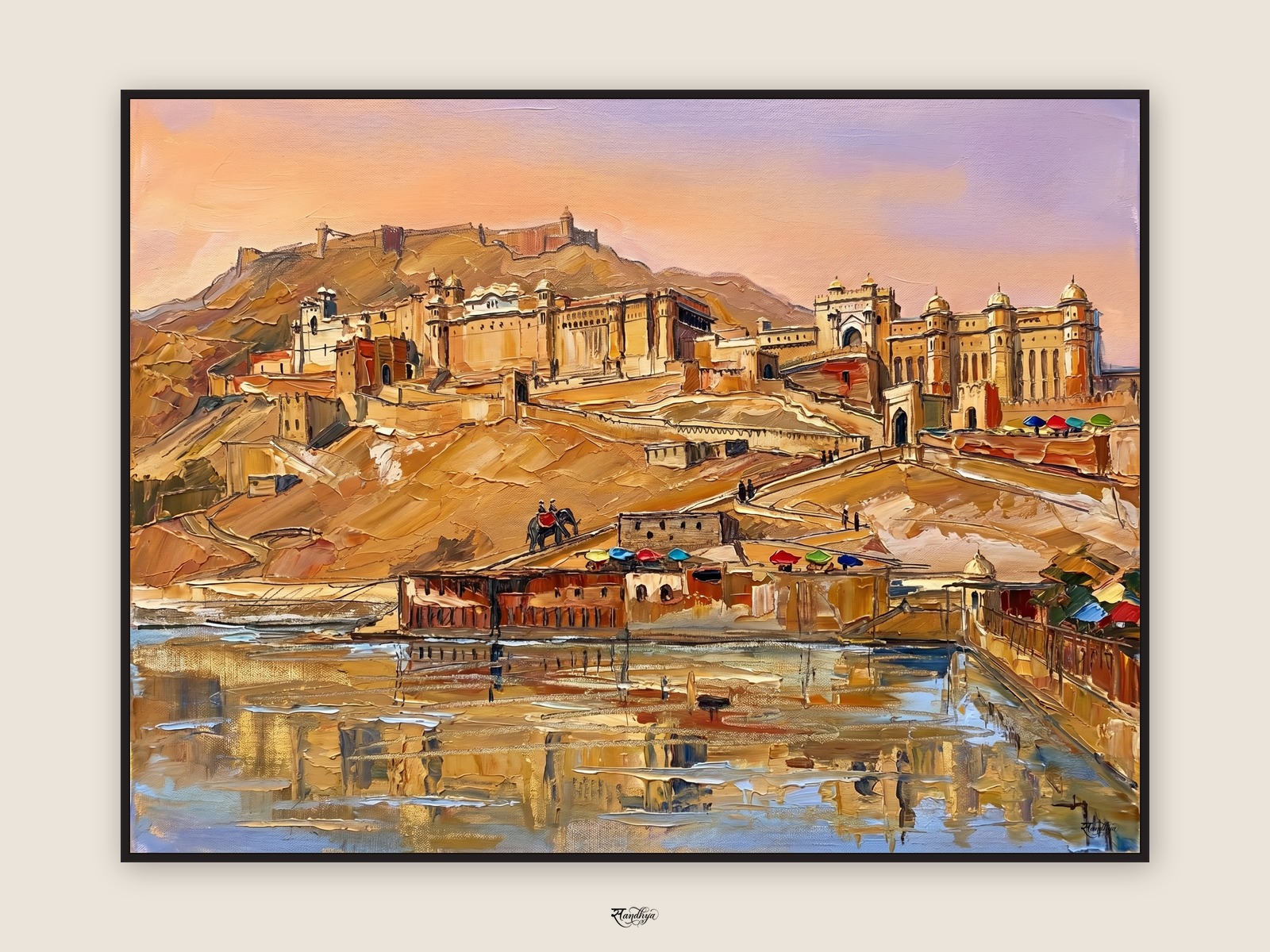
Amber Fort rises from the Aravalli hills like a sandstone apparition — its ramparts, gateways, and palace complex reflected in Maota Lake below. Sandhya paints it at the golden hour, when the fort's honey-coloured walls deepen to burnt sienna and the surrounding hills turn purple-brown in the fading light.
The palette knife work here is architectural in the truest sense. The fort's massive walls are built in broad, horizontal strokes of warm ochre and raw sienna, each stroke suggesting a course of dressed stone. The gateways and arched openings are carved out in darker tones — burnt umber and deep brown — creating the illusion of depth and shadow within the fortress. Above, the palace pavilions and jharokhas catch the last direct sunlight in strokes of pale gold and cream, their Rajput elegance suggested through rhythm rather than detail.
The lake in the foreground is a masterclass in restraint. Painted in horizontal strokes of muted blue, grey, and reflected amber, it mirrors the fort in broken, impressionistic fragments — never a literal reflection but an emotional one. The colourful market stalls along the lakeshore add notes of magenta, turquoise, and saffron, providing a human scale against the fort's monumental presence. Jaigarh Fort is visible on the ridge above, a darker silhouette establishing the deeper hills behind.
What is Amber Fort in Jaipur?
Amber Fort (also spelled Amer Fort) is a 16th-century Rajput fortress located in the Aravalli hills near Jaipur, Rajasthan. Built from red sandstone and marble, it combines Hindu and Mughal architectural elements. Sandhya Kaushik captures it reflected in Maota Lake at golden hour, using palette knife impasto to convey the weight and warmth of centuries-old stone.