Chittorgarh Vijay Stambh
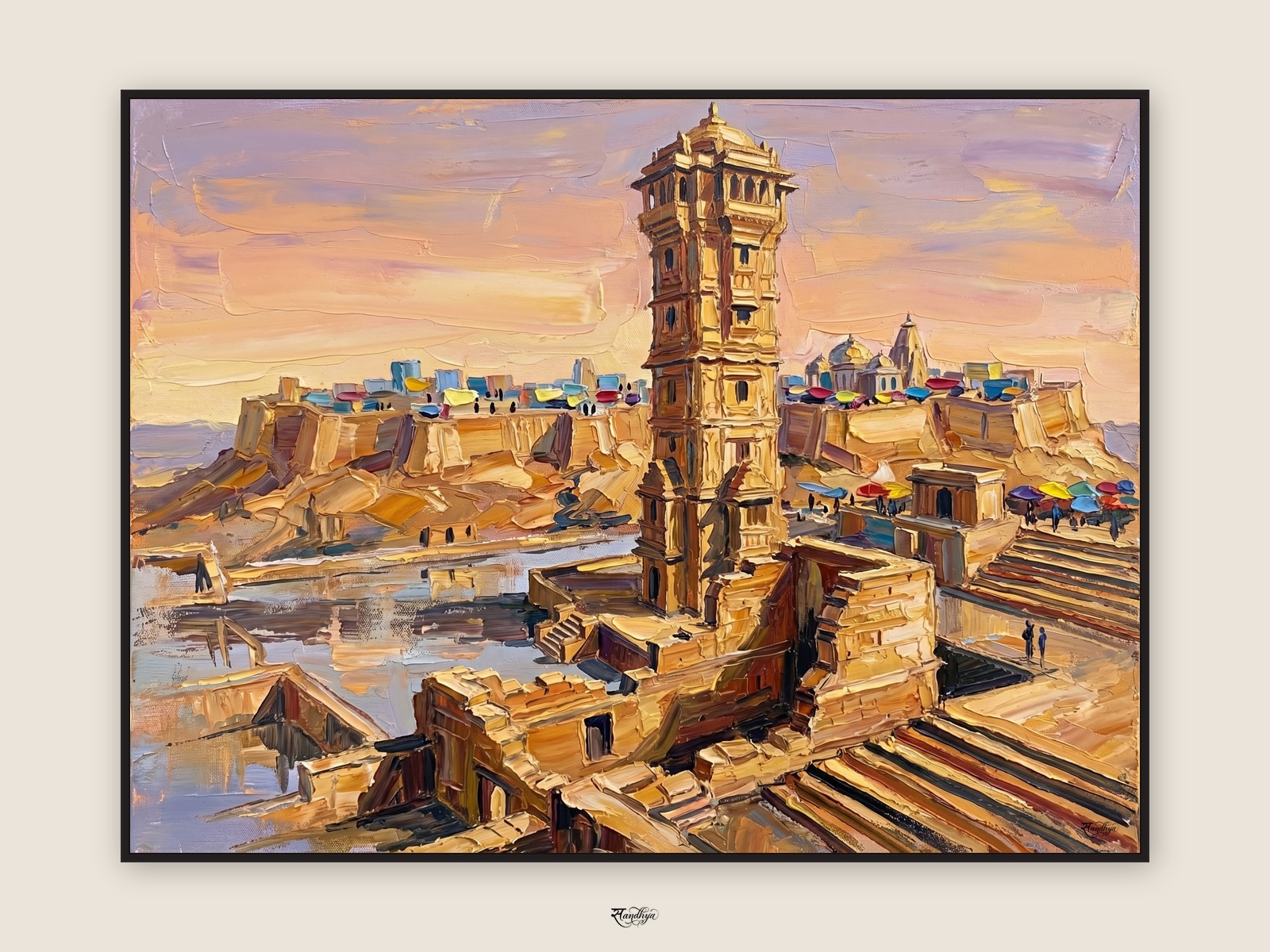
The Vijay Stambh — Victory Tower — rises nine storeys above the plateau of Chittorgarh Fort, its carved sandstone silhouette commanding the composition like an exclamation mark against a sunset sky of coral and gold. Built by Maharana Kumbha in 1448 to celebrate his victory over the Malwa sultanate, it stands here as Sandhya paints it: solitary, vertical, and defiant against the vast horizontal sweep of the Rajasthani plains.
The tower itself is the painting's centrepiece. Sandhya renders its nine storeys in warm tones of golden ochre, deep sandstone, and burnt sienna, each level distinguished by carved balconies, Hindu deity sculptures, and ornamental bands suggested in thick impasto marks. The intricate carvings — which in reality depict scenes from the Ramayana and Mahabharata — are evoked through textural variation rather than literal detail: dense, rhythmic knife-strokes that create surface complexity without attempting miniature precision. The tower's proportions are faithfully observed — it narrows slightly as it rises, the uppermost storey crowned by a dome visible against the sky.
Around the tower, the fort plateau stretches in all directions. Ruined temples, palace walls, and subsidiary structures are rendered in muted earth tones — burnt umber, raw sienna, warm grey — suggesting the vast scale of a fort that once enclosed a complete city. The ground is painted in broad strokes of dusty ochre and olive, with scattered architectural fragments catching light. In the distance, the Rajasthani plains extend to the horizon in thin washes of pale brown and hazy blue. The sky is the painting's second triumph — bands of warm gold, coral pink, soft lavender, and pale blue that graduate from horizon to zenith, their warmth reflected in the tower's upper storeys. Small figures at the tower's base provide scale — and the scale is staggering. This single tower, standing amid the ruins of a fort that endured three legendary sieges, is Sandhya's monument to Rajput memory: what remains when everything else has fallen.
What is the Vijay Stambh at Chittorgarh?
The Vijay Stambh (Victory Tower) is a nine-storey, 37-metre tower built by Maharana Kumbha of Mewar in 1448 to celebrate his victory over Sultan Mahmud Khilji of Malwa. Located within Chittorgarh Fort — the largest fort in India — it is intricately carved with images from Hindu epics and Jain iconography. Sandhya Kaushik paints it standing alone against the sky, emphasising the tower's role as the enduring symbol of Rajput pride amid a fort that witnessed three historic sieges and three acts of jauhar.