Jaipur Hawa Mahal
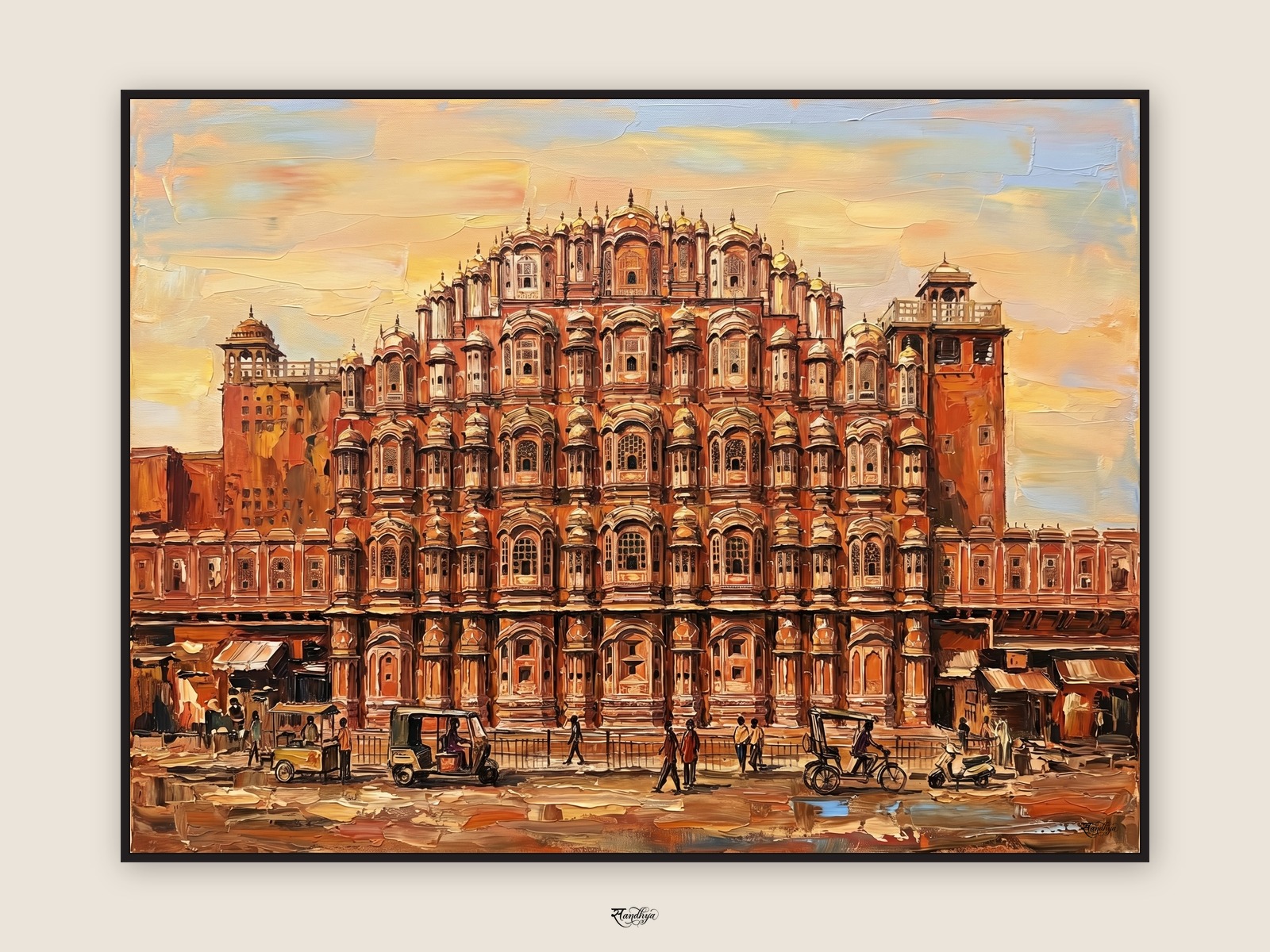
Hawa Mahal — the Palace of Winds — fills the canvas with its extraordinary honeycomb facade, five storeys of pink sandstone jharokhas rising in a pyramidal cascade that Sandhya renders in dense, architectural impasto. This is not a distant postcard view but a close confrontation with the facade's impossible intricacy, painted from the street below with the building looming upward against a warm golden sky.
The facade is a tour de force of palette knife control. Each of the 953 small windows is suggested — not individually detailed but rhythmically implied — through repeated strokes of deep rose, warm terracotta, and burnt sienna, with darker shadows of umber carved into the recesses between projecting jharokhas. The sandstone catches the light in graduating tones: the upper storeys in pale salmon and cream where the sun strikes directly, the middle registers in rich pink and coral, the lower levels in deeper shadow tones of russet and brown. Ornamental details — the scalloped arches, the fluted pilasters, the crown-like finials at the roofline — are picked out in quick strokes of pale gold and bright ochre.
At street level, the painting shifts from architectural portrait to urban scene. Auto-rickshaws, cycle carts, and pedestrians populate the road in small, energetic strokes — a yellow rickshaw, a dark bicycle, figures in bright saris crossing the street. Market stalls with awnings in faded red and blue line the base of the building, their merchandise suggested in colourful dabs. The flanking buildings in darker sandstone and brown create a visual frame that pushes the Hawa Mahal forward. This is Jaipur's most photographed facade painted as a living part of the city's daily commerce, not a museum piece behind a rope.
What is Hawa Mahal and why is it called the Palace of Winds?
Hawa Mahal is a five-storey palace in Jaipur, Rajasthan, built in 1799 by Maharaja Sawai Pratap Singh. Its 953 small jharokha windows were designed to allow royal women to observe street life without being seen, while the honeycomb structure channelled cool breezes through the palace — hence 'Palace of Winds.' Sandhya Kaushik paints it from street level, capturing both the facade's architectural wonder and the everyday commerce that flows beneath it.